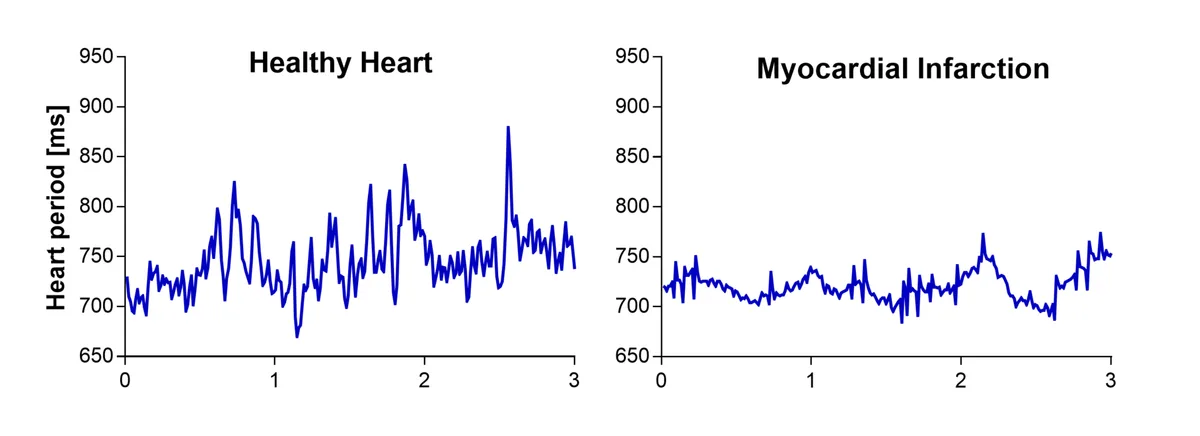
Wearables measure heart rate variability by timing the tiny swings between heartbeats. A chest strap reads the heart's electrical signal directly. Watches and rings shine light into the skin and track the pulse wave instead. A 2013 review of comparison studies found the two routes agree well at rest, and drift apart with movement.
The number behind the trend line, usually RMSSD in milliseconds, comes from the same source either way: the spacing of beats, one to the next. What differs is how the device captures that spacing, and how much noise rides along. This science hub keeps track of the measurement research behind training gadgets.
The lab-versus-gadget gap runs across sports technology, and this look at fat adaptation and low-carb endurance covers another case where field tools simplify a messy physiology. Here, the question is narrower: how does a plastic band turn light into a heart metric, and how close does it land?
What Is Heart Rate Variability, Exactly?
It is the beat-to-beat variation in heart timing, measured in milliseconds. A resting heart is never a metronome; the gaps between successive beats wobble by small amounts, and those wobbles track the autonomic nervous system's push and pull. Researchers compress them into metrics. RMSSD, the root mean square of successive differences, is a wearable favorite. The gold-standard capture remains an electrocardiogram, which records each beat's electrical spike.
Chest straps read that same electrical signal at the skin, so their numbers sit closest to the medical standard. The catch is comfort. Nobody sleeps in a lab setup by choice, which is exactly why consumer devices went optical.
How Does a Watch or Ring Detect It?
Most skip the electricity and read the plumbing instead. The technique is photoplethysmography. It is a low-cost optical method that tracks changes in blood volume inside tissue, per a review in the journal Biosensors. An LED lights the skin, a sensor watches the light bounce back, and each heartbeat leaves a small ripple in the signal.
The device then times the spacing of those ripples. Variability math runs on those pulse intervals. That stand-in has its own name, pulse rate variability, because it is derived from the pulse wave rather than the heart's electrical firing. The 2013 review treats PRV as an estimate of HRV. Close, but not identical.
How Close Do the Two Methods Get?
Close at rest, and less so under strain. The review judged pulse-based readings sufficiently accurate in resting subjects. One twist: short-term variability came out somewhat overestimated. Breathing couples into the pulse wave. Physical activity and some mental stressors impaired the match with true HRV, sometimes to an unacceptable extent.
A 2022 lab study funded by the Australian Institute of Sport put numbers on it. Six wearables were tested in 53 active adults against an ECG during sleep. Absolute error in RMSSD ran about 19 to 33 milliseconds on three wrist-worn devices, with limits of agreement as wide as 92 milliseconds either way. The companies had no input into the design or the results.
Why Do Readings Jump From Night to Night?
Because light through skin inherits every weak point of light through skin. The Biosensors review sorts the noise into three buckets: traits of the wearer, such as skin tone and age; physiology, such as breathing and the body site measured; and outside interference, such as motion, ambient light, and pressure on the sensor.
A band that shifts a centimeter during sleep changes its own optics. Add breathing changes, room temperature, and caffeine. The morning number then moves for reasons outside recovery. A trend line is general information, not individualized advice; questions about heart rhythm belong with a qualified professional. Readers following this should also see How Heat Training Changes Endurance, According to Researchers.
Conclusion: A Window, Not a Verdict
Wearables earn their HRV number honestly. Light, blood volume, pulse intervals, then arithmetic. The physics is sound and the resting numbers are decent. The error bars are real, though, wider than the daily changes users chase. Read the trend loosely, treat single days as noise, and let the ECG keep its gold.