Fat adaptation — training the body to burn more fat and less carbohydrate through low-carbohydrate diets — works mechanically: well-controlled studies, most prominently Louise Burke's 2017 trial with world-class race walkers at the Australian Institute of Sport, show keto-adapted athletes can burn fat at extraordinary rates. But the same trial found the low-carb group failed to improve race performance while carbohydrate-fueled groups did, and the walkers' economy — the oxygen cost of walking fast — got slightly worse. Fat adaptation is real physiology that has not translated into better racing for elite endurance athletes.
Why did fat adaptation become popular in endurance sport?
The appeal is arithmetic. Body carbohydrate storage — muscle and liver glycogen — is limited, roughly 400 to 600 grams, and depleting it is a central cause of hitting the wall in long events. Body fat stores, even in lean athletes, hold tens of thousands of calories. A metabolism that runs mostly on fat would, in theory, remove the fuel ceiling entirely. The argument was sharpened by researchers Timothy Noakes and Stephen Phinney, whose case studies of keto-adapted ultrarunners kept the idea in the field's conversation through the 2010s.
The zero-events-that-mattered evidence gap — a controlled performance trial in truly elite athletes — was what Burke's team set out to close.
What did the 2017 race walker trials find?
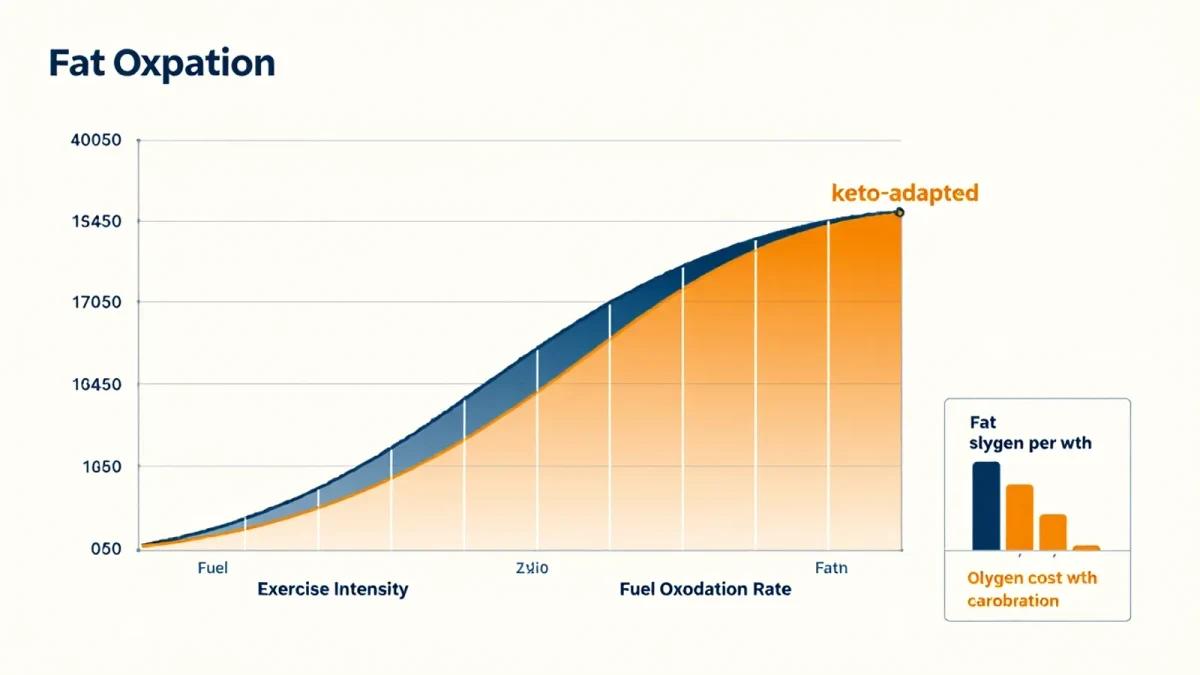
Burke's study, published in the Journal of Physiology as a coordinated series, divided internationally competitive race walkers into matched groups for three weeks of intensive training: one on periodized carbohydrate availability, one on high carbohydrate throughout, and one on a ketogenic low-carb diet. The results gave the fat-adaptation camp and the carbohydrate camp each their exact finding. The keto group dramatically increased peak fat oxidation — rates approaching 1.5 grams per minute, among the highest recorded — and improved aerobic capacity in absolute terms.
But race performance over 10-kilometer time trials improved in both carbohydrate groups and not in the keto group, and the keto walkers' exercise economy declined: they needed more oxygen to walk at the same speed. Fat, it turns out, yields less energy per liter of oxygen than carbohydrate — the metabolic equivalent of a fuel with lower energy density.
The trial was small, three weeks may be short for full adaptation, and the design has been debated since publication. What it did establish is that fat adaptation's costs and benefits can be measured in elite humans — and that in that measurement, the benefits did not include going faster.
Can low-carb training still be useful?
There is a defensible middle ground, and it is not full keto. Training with low carbohydrate availability in selected sessions — training twice a day with limited refueling, or long runs before breakfast — increases mitochondrial biogenesis and fat-oxidation capacity without maintaining a ketogenic diet, a strategy reviewed extensively under the name sleep-low or train-low by researchers including Burke and Keith Baar. Meta-analyses of train-low approaches find improved fat oxidation and, in some studies, equivalent performance gains to high-carb training — with evidence that chronic low availability impairs high-intensity work when overused.
The current consensus position, reflected in sports-nutrition reviews, is that most sessions should be fueled, a minority deliberately under-fueled, and competition fully fueled.
Who might full fat adaptation suit?
Honest answers are narrower than the marketing. Ultra-distance events at genuinely low intensities — where fat supplies most energy anyway — plausibly fit the physiology better than 10K racing. Athletes with metabolic conditions sometimes adopt low-carb diets for health reasons and train successfully on them. And individuals vary: the race-walker trial's non-responder spread was wide.
What the evidence does not support is the claim that keto-adaptation is a general endurance upgrade. After nearly a decade of debate since 2017, no controlled trial in elite athletes has shown it.
What does this mean for a recreational endurance athlete?
Practically: carbohydrate remains the best-tested performance fuel for anything faster than a shuffle, and full fat adaptation trades a proven input for an unproven one. Selected low-carb sessions, used sparingly, are a legitimate training stimulus. Beyond that, the fueling question is dominated by ordinary diet quality and total energy availability — chronically under-fueling on any macronutrient split impairs performance and health, per the International Olympic Committee's consensus on relative energy deficiency in sport.
What happened in the debate afterward?
The 2017 papers triggered one of sports nutrition's sharpest public exchanges. Critics of the trial argued three weeks was too short for full keto adaptation, pointing to case studies and Phinney's earlier work suggesting longer timelines. Burke's group responded that no controlled evidence had ever shown the benefit proponents described at any timeline, and that waiting for adaptation beyond a month in elite athletes, whose seasons are short, was asking the question in a form no team could use.
Subsequent research has landed closer to Burke's position: follow-up studies and reviews through the early 2020s found improved fat oxidation without performance improvements, and several found the same economy penalty. Meanwhile the carbohydrate-periodization camp absorbed part of the low-carb argument — selected under-fueled sessions as a training tool — which is where the field now largely stands.
The bottom line
Fat adaptation does what it claims metabolically and not what it promises competitively: keto-adapted elite walkers burned record amounts of fat and raced no faster — slightly less economically — than carbohydrate-fueled teammates in the definitive 2017 trial. Selected train-low sessions capture much of the adaptation without the diet. The literature is catalogued on PubMed.