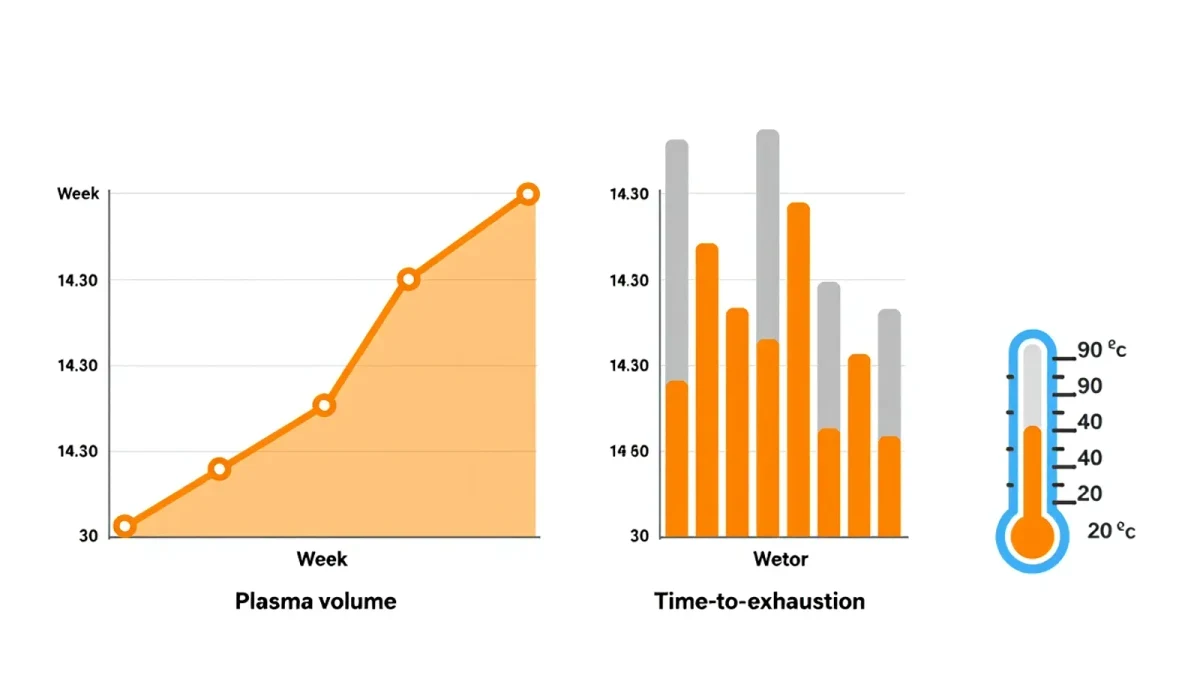
Supercompensation is the idea that a training stress temporarily lowers your capacity, recovery restores it, and a modest overshoot follows — leaving you slightly fitter than before — and while exercise physiologists treat the classic curve as a simplified picture of a messier process, its practical core is well supported: adaptation happens during recovery, not during the workout, so training hard without timed rest produces staleness instead of progress. The concept traces to Hans Selye's general adaptation syndrome from the 1930s and was formalized in sports-science literature in the decades after.
Understanding where the model holds — and where its tidy curve breaks — is genuinely useful for programming decisions from session spacing to deload weeks.
Where did the model come from?
Selye, an endocrinologist, described a three-stage response to stress in laboratory animals: alarm, resistance and exhaustion. Eastern European training theorists adapted the framework in the mid-20th century, arguing that a training load digs a hole in the body's resources, and that the hole refills past baseline if recovery is allowed before the next stress — the overshoot being the super in supercompensation. The idea justifies nearly everything recognizable in programming: easy days after hard days, rest between intervals, taper weeks before competition.
Direct measurement of the overshoot in humans is thinner than the diagrams imply. What is well documented is the failure mode: unremitting stress without recovery produces performance decline, illness and injury risk — the exhaustion branch of Selye's model.
How does the fitness-fatigue model improve on it?
The supercompensation curve assumes one stress and one recovery. Real training stacks stresses, so physiologists including Eric Banister proposed the fitness-fatigue model in the 1970s: every session generates two aftereffects simultaneously — a long-lasting fitness gain, and a shorter-lived fatigue that masks it. Performance at any moment is roughly fitness minus fatigue. Hard training raises both; the taper works by letting fatigue decay faster than fitness, revealing the fitness that was masked.
The model explains what supercompensation cannot: why athletes often perform best two weeks after their hardest training block, not during it, and why cumulative load matters more than any single session's recovery curve. Modern versions, refined by researchers such as Andrew Renfree and colleagues, fit training-and-performance data reasonably well at the individual level, though with enough error that they inform rather than dictate coaching.
How long does recovery between hard sessions take?
The stock answer is 24 to 72 hours, and it is roughly right with big individual variation. A hard but non-damaging interval session might need a day; a heavy eccentric session or a race — producing muscle damage and strength loss lasting several days in the damage literature — can suppress performance for three days or more. Glycogen, the muscle's carbohydrate fuel, typically refills within about 24 hours given adequate carbohydrate intake.
None of those clocks requires passivity. Active recovery — easy movement well below threshold — supports blood flow and, in many trials, subjectively better recovery than total rest, without changing the underlying timeline much.
Why does adaptation need the overshoot at all?
Because the body rebuilds conservatively. Muscle protein synthesis runs elevated for 24 to 48 hours after resistance training, mitochondrial biogenesis proceeds over days after hard endurance work, and blood-volume adaptations accumulate over weeks. Each rebuild is a construction project launched by the stress and completed in rest. Training again mid-construction is not automatically wasted — fitness-fatigue interactions can compound positively — but chronic mid-construction reloading with insufficient recovery is the classic route to overreaching.
How do you use this in a training week?
- Space truly hard sessions 48 to 72 hours apart when they stress the same systems.
- Alternate systems on consecutive days — a hard run and a heavy upper-body session interfere less than two hard runs.
- Program a lighter week every three to six weeks, before performance forces it.
- Taper by cutting volume sharply while keeping some intensity, letting fatigue decay while fitness holds.
That fourth point is the taper evidence in brief: analyses of tapering studies, including work by Laurent Bosquet and colleagues, consistently show performance gains of roughly 2 to 3 percent when training volume drops substantially for one to two weeks while intensity is maintained.
Where does the model mislead?
Three places. First, the textbook curve suggests timing precision — train again at the exact peak of the overshoot — that no measurement system in daily use can locate, and chasing it produces spreadsheet anxiety rather than fitness. Second, supercompensation diagrams imply fitness decays back to baseline within days if you miss the moment; in reality, retained training adaptations fade over weeks, which is why a missed week costs far less than the diagrams suggest. Third, the model says nothing about which stress produces which adaptation — that specificity comes from the training itself.
What signals the balance is tipping the wrong way?
The body files its complaints before performance collapses, and the pattern is consistent enough to watch for. Waking heart rate drifting up across consecutive weeks, sleep that stops refreshing despite normal hours, and a flat emotional response to training sessions that used to excite — each is a documented early marker in the overtraining literature, alongside small but persistent performance declines in standardized efforts.
The remedy, aligned with the fitness-fatigue logic, is a load reduction rather than a training-content overhaul. Cutting volume by a third to a half for a week, keeping some intensity and sleeping on schedule, restores most athletes within one to two weeks when caught early. Athletes who push through early warnings spend months rather than weeks recovering, a trade the model — and every coach who has watched it happen — argues against.
The bottom line
Stress, recover, adapt slightly above baseline: the supercompensation story is the right first approximation, and the fitness-fatigue model is the better second one. Both reduce to the same coaching instruction — hard enough to stimulate, recovered enough to absorb — and both warn against the same mistake, which is mistaking fatigue for fitness. The modeling literature is catalogued on PubMed.