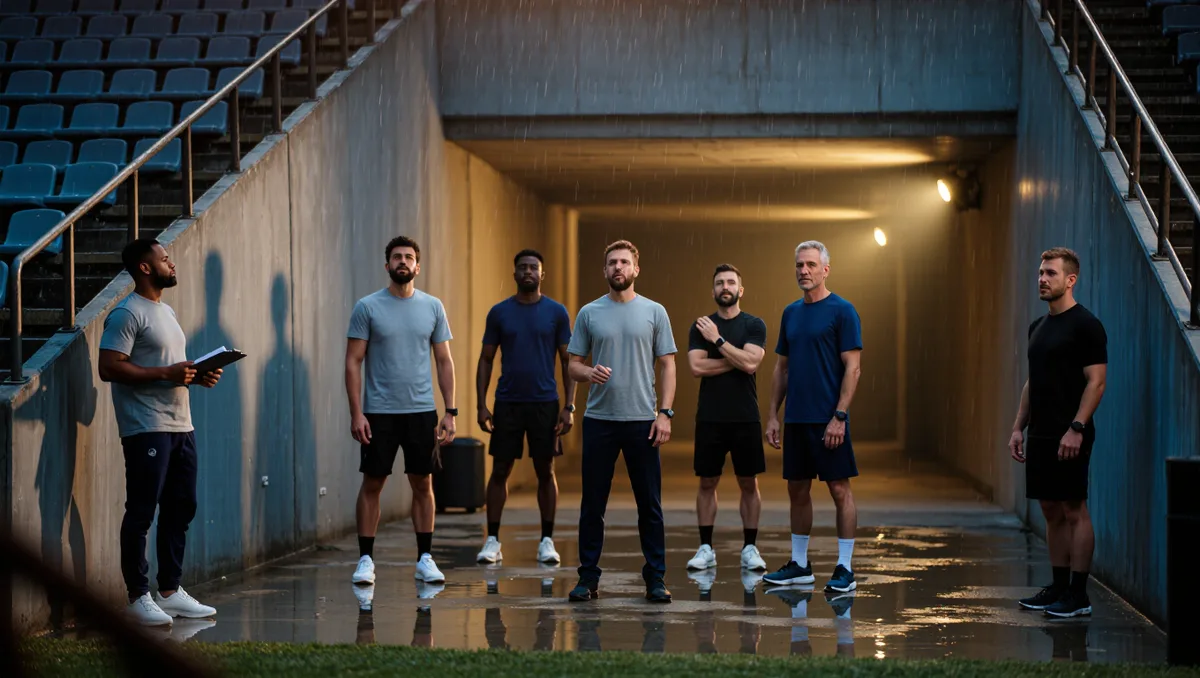
The gap between a good athlete and a great one is smaller than it looks and larger than it feels. Physically, the top performers in any sport cluster tightly: the fitness differences inside a professional squad are often modest. What tends to separate the best is what they do with that fitness — how quickly they read a situation, how well they choose, and how deliberately they train the things that are actually trainable.
This is an explainer, not a training manual. The research on expertise is broad but rarely tidy, and much of it comes from small studies of specific sports rather than grand unified laws. What follows is the honest shape of the evidence: where the differences show up, which ones respond to training, and which ones you should be suspicious of when a pundit reaches for them.
What does "elite" actually mean?
It helps to define the term before arguing about it. An elite athlete, in the way researchers and analysts use the word, is someone competing at or near the top of a sport's competitive pyramid — professional ranks, national teams, international finals. Below that sits a wide band of very good athletes: strong club players, competitive amateurs, squad professionals who never quite become starters.
The interesting finding from decades of talent research is that the physical gap between those two bands is often narrow. Two midfielders can post similar sprint times and similar endurance numbers, and one of them consistently makes better choices with the ball. That is not an accident, and it is not luck. It points to where the real sorting happens: in perception and decision-making, layered on top of a physical base that gets you into the room but does not win the argument once you are there.
There is also a survivorship problem worth naming. We only see the athletes who made it, so every elite performer looks, in hindsight, like the inevitable product of their path. The athletes who trained just as hard and fell short are invisible in the story. Any account of greatness that ignores them is selling a narrative, and this desk has a standing rule: if the number does not survive a second viewing, neither should the story built on it.
How much of performance is actually trainable?
More than the talent-obsessed believe, less than the hustle-industrial complex promises. The honest version sits in the middle.
Physical qualities respond to training — that is the entire basis of coaching. Aerobic capacity, strength, speed reserve and mobility all improve with structured work, though the rate of improvement varies enormously between individuals, and genetics sets the ceiling as well as the slope of the curve. Two athletes on identical programs will not arrive at identical results. Coaches know this from experience; exercise scientists have documented it repeatedly in training studies, where the spread of individual responses within a single group is often as striking as the group average.
Trainability itself may be the underrated trait. The athletes who improve most over a career are frequently not the most impressive eighteen-year-olds. They are the ones whose bodies and minds absorb training well: they adapt, they recover, they stack season on season. A promising junior who plateaus is a familiar figure in every sport. The less heralded one who keeps getting better for a decade is rarer, and in the long run more valuable. Career length compounds; our own coverage of the habits that extend athletic careers makes the same point from the other direction.
What this means in practice: talent identification that overweights current performance tends to select for early developers, not eventual elites. The research on youth pathways keeps circling back to this, and it is one of the few places where the evidence and the scouting folklore genuinely disagree.
Why decision speed separates athletes
Watch sport with the commentary off and a different game appears. Before the pass is thrown, the receiver has already decided where to go. Before the tackle arrives, the ball carrier has already shifted weight. Elite performers are not reacting faster in a simple reflex sense — raw reaction time differences between good and great athletes are modest. They are perceiving sooner and more accurately, which buys them time that looks like speed.
Researchers call the underlying skill perceptual-cognitive ability: reading patterns, anticipating outcomes, extracting the relevant information from a cluttered scene while ignoring the rest. Studies using eye-tracking and temporal occlusion — where viewers see only the first part of an action and must predict the outcome — have found that elite players predict what happens next more accurately and from less information than lesser players. They do not watch the ball flight; they watch the passer's hips and shoulders. The expert extracts the signal earlier.
Crucially, this skill is sport-specific and experience-driven. A great footballer reading a defensive shape does not automatically read a cricket field or a basketball pick-and-roll. The pattern library is built through exposure, which is one reason multisport backgrounds can still produce elite specialists later: the general athletic base transfers, the specific patterns get built on top. Our look at early specialization versus multisport paths covers that debate in detail. We covered a connected angle in Early Specialization vs. Multisport: What Research Says.
Under fatigue and pressure, decision quality degrades — and it degrades unevenly. The athletes who keep choosing well late in matches are not merely tougher; their well-practiced decisions are more resistant to the noise that exhaustion and crowd pressure inject. Automaticity, the product of thousands of correct repetitions, is what survives the storm.
What deliberate practice actually looks like
Deliberate practice is a specific idea, not a synonym for hard work. In the research tradition it means practice that is structured around identified weaknesses, gives immediate feedback, sits at the edge of current ability, and is often not much fun. Drills you already perform well feel productive. Deliberate practice usually feels uncomfortable, because it lives exactly where you keep failing.
The popular version of this research — the claim that roughly ten thousand hours of practice makes an expert — has traveled far beyond what the original studies supported. The hours matter, but the quality of the hours matters more, and the relationship is not a simple formula. Some athletes accumulate enormous volumes of practice and plateau. Others convert fewer, better-designed hours into large gains. Deliberate practice is a strong predictor of expertise in the research literature, but it explains a portion of the variance, not all of it, and nobody should quote a single magic number.
The practical signature of deliberate practice is visible in how elite athletes train versus how good ones train. The good athlete repeats what works. The great athlete spends a disproportionate share of sessions on the weakest link, with feedback loops tight enough to catch errors quickly. That is also where good coaching earns its keep: a coach who can diagnose the weak link and design the drill is worth more than the extra hour.
What this means for the rest of us
Strip the mythology and a usable picture remains. Greatness in sport is usually the compound interest of three things: a physical base that training built, a decision-making library that experience built, and practice habits sharp enough to keep improving when improvement gets hard. None of the three is glamorous. All three are observable, which makes them far more useful than talent talk.
For athletes and coaches reading this, the honest application is diagnostic rather than inspirational. If performance has plateaued, the question is which of the three is the weak link — fitness, reading the game, or practice design — and the answer usually shows up on video before it shows up in a lab. For fans and pundits, the application is skepticism: when a highlight is explained by "he wanted it more," check whether the player simply saw the play develop a half-second earlier. Most great decisions look like genius only in replay. For anyone making personal training or health decisions, this article is information, not advice — a qualified coach or clinician should be the one tailoring anything to your body.
What remains unknown is the part that keeps talent research honest: how much of the residual — the difference between two equally trained, equally driven athletes — comes down to factors we cannot yet measure or name. The evidence supports the trainable portion of greatness. It does not promise that training is the whole story, and no serious researcher claims otherwise.
Sources: ifann.net · screenrant.com