Sprint speed comes down to how hard and how briefly you hit the ground: the landmark research by Peter Weyand and colleagues, published in the Journal of Applied Physiology in 2000, found that faster top running speeds are achieved by applying greater vertical forces to the ground during shorter contact times — not by moving the legs faster through the air. That single finding organizes nearly all modern sprint coaching.
The legs of the fastest sprinters reposition in the air no faster than those of average runners. What separates them is what happens in the roughly tenth of a second their feet spend on the ground.
What are the two phases of sprinting?
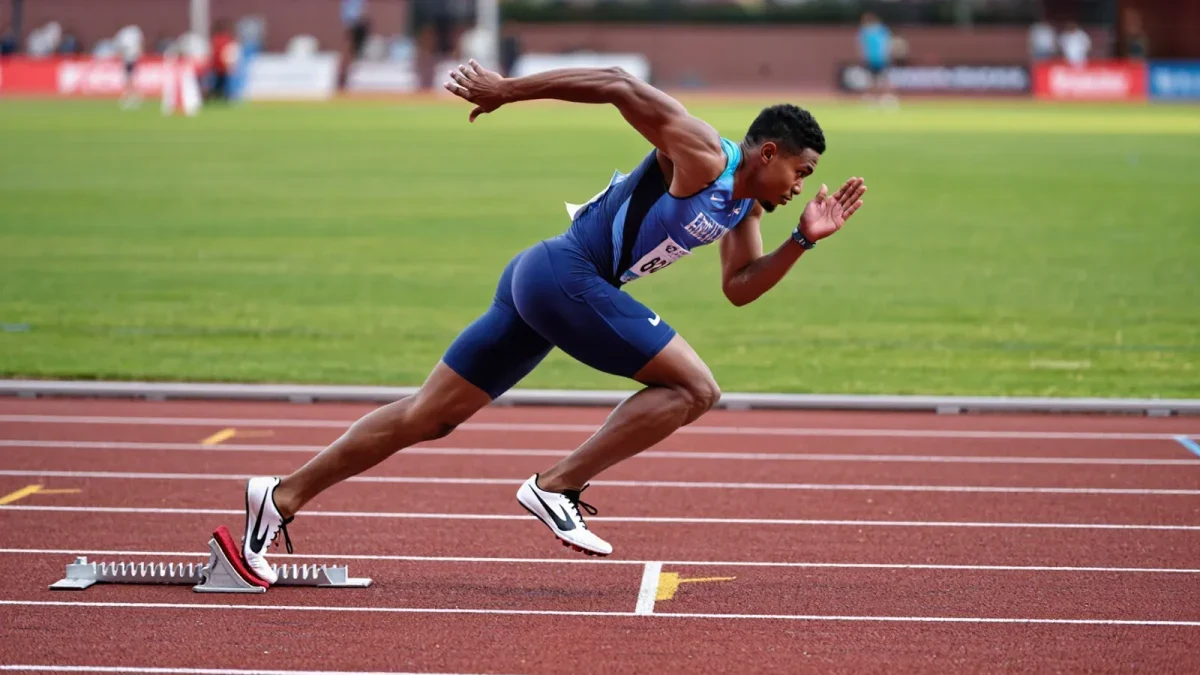
Every sprint divides into acceleration and maximum velocity, and they are nearly different sports. Acceleration — the first ten to twenty meters from a stationary start or a jog — is a pushing phase: body angled forward at roughly 45 degrees, long ground contacts, force directed horizontally backward, stride length growing step by step. Maximum velocity — reached around 40 to 60 meters in elite sprinters — is a vertical-bounce phase: upright torso, contact times near 0.09 seconds, force directed almost straight down, stride length and frequency balanced at their combined optimum.
Coaches separate them because training them is different. Acceleration is strength-dominant, resembling a series of short heavy pushes; top speed is stiffness- and elasticity-dominant, resembling a stiff pogo. The drills, the lifts and the cues that help one often do nothing for the other.
What did Weyand's research actually show?
Weyand's team measured runners at speeds up to 11.1 meters per second on a force-measuring treadmill and reported that ground contact forces rose steeply with speed while swing-cycle rates — how quickly legs repositioned — barely differed between fast and slow runners. Follow-up work from the same group found peak forces on the ground at top speed exceeding two times bodyweight per leg, delivered in under a tenth of a second.
The interpretation changed coaching: since swing speed is roughly a wash across ability levels, the trainable difference is force application — how much force, in which direction, over how little time. Strength work, plyometrics and technical work that improve those three variables have a mechanism; arm-pumping drills aimed at turnover for its own sake mostly do not.
What does good acceleration mechanics look like?
The first steps of an acceleration share a short checklist. Shin angle: the front shin matches the trunk's forward lean, so each push drives the body forward rather than up. Strike pattern: the ball of the foot lands under or slightly behind the hips, never far in front, where it would brake. Arms: driven back with the elbow, aggressive and short, matching the legs' rhythm. Head: neutral with the spine, eyes on the ground a few meters ahead rather than up at the finish.
The commonest fault is standing up too early — popping upright within the first three steps and forfeiting the forward-push geometry. The commonest cue against it is simple patience: stay low, let the rise happen naturally as momentum builds across ten to twenty meters, and never try to reach full stride length in step two.
What changes at maximum velocity?
Upright posture, for a start: the trunk reaches a slight forward lean, pelvis neutral, and the runner "runs tall" rather than leaning. Ground preparation becomes the skill — the foot accelerates backward and downward before contact, so it lands with the ankle stiff and the hip already over it, what sprint coaches call negative foot speed. A passive landing foot, drifting out ahead of the body, is the braking error that separates decent sprinters from fast ones at top speed.
Contact time is the metric under everything. Elite women and men touch the ground for roughly 0.08 to 0.11 seconds at top speed; recreational sprinters sit near 0.15 or more. Plyometric training, described in the jumping research of Markovic and later dose-response meta-analyses, is the best-evidenced route to shorter, stiffer contacts.
Which drills and lifts actually transfer?
Evidence-backed sprint training is unglamorous: sprinting itself, done fast and fresh, is the primary stimulus — studies of sprint training consistently improve sprint performance with as little as one high-quality session weekly. Around it, the supporting cast is short.
- Hill sprints for acceleration: the slope enforces forward lean and shin angle while reducing impact.
- Short fly-in runs at 95 percent effort for top speed, with full recovery — six to eight minutes between reps, because speed work is phosphocreatine work.
- Pogo hops and bounds for stiffness and elastic contact quality.
- Heavy squats, split squats and hip thrusts for the force side of Weyand's equation — the meta-analyses of strength training in sprinters report small but consistent improvements in sprint times.
- Sled pushes and heavy short sled pulls for horizontal force, a programming pattern supported by sprint-training reviews.
The full recovery rule deserves emphasis. Sprint work dies of fatigue management failures more than program design: a sprint session degraded into fast-but-tired running trains nothing but bad habits. Speed before volume, always, and rarely more than two or three true speed sessions per week in a mixed program.
How do you spot technical faults without a coach?
Video, from the side, at 60 frames per second or better on any modern phone, against a short checklist: is the rise to upright gradual across the first fifteen meters? Does the foot land under the hip at top speed? Is the backswing of the arm driving from the elbow? Three angles of the same run beat thirty reposted drills.
Two self-tests also travel well. A standing long jump or a 10-meter time from a still start estimates acceleration qualities; a 30-meter fly time estimates top speed. Tracking those numbers across a season tells a self-coached runner more than any mirror ever could, and gives the sprint-mechanics literature — much of it indexed on PubMed — a practical scoreboard.
Does sprint mechanics coaching matter for team athletes?
More than for track sprinters, oddly. Soccer, rugby, football and basketball players accelerate and decelerate constantly, rarely reaching true top speed — so the pushing phase carries most of their sprinting value, and it is the phase most responsive to strength and sled work. Reviews of sprint training in team-sport athletes report meaningful improvements in sprint times from both technical and strength interventions.
Aging athletes get a specific dividend: sprinting at genuine effort preserves fast-twitch muscle and tendon stiffness that steady-state exercise does not, a reason many strength coaches program short accelerations for healthy clients well past forty. Elite Sports Mag publishes information, not training advice; readers returning to sprinting after injury should progress under a qualified professional.