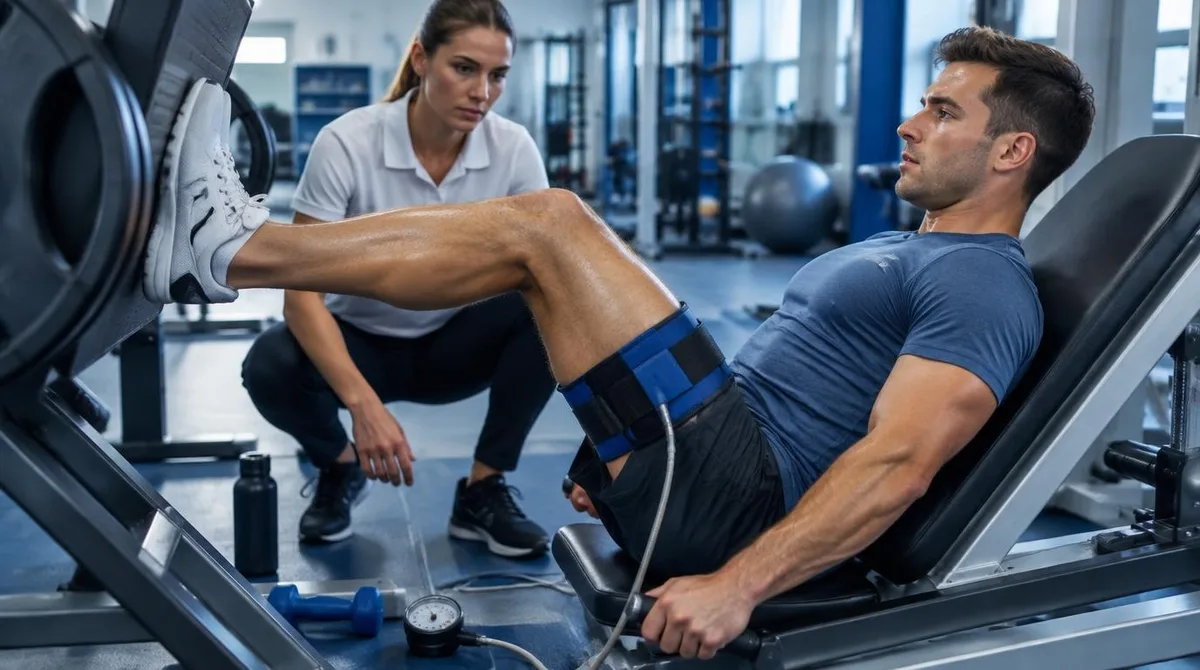
Blood flow restriction training is lifting light weights while a cuff squeezes the top of the limb. The restriction slows the return of venous blood, the muscle works under stress it would not normally meet at that load, and the research says it can build muscle and strength. The honest weight of that evidence: real effects, mostly in rehab settings and older adults, mostly compared against doing very little rather than against heavy lifting.
That last point matters. If you are healthy and can lift heavy, heavy lifting remains the benchmark. Blood flow restriction, or BFR, earns its place when injury, surgery, or joint pain makes heavy loading impossible — and that is exactly where most of the published trials sit.
What is blood flow restriction training, exactly?
BFR is a category of low-load training that uses an inflatable cuff or wrap to partially limit circulation in a working limb. The idea is simple plumbing. Arteries carry oxygen-rich blood from the heart out to the tissues, while veins carry oxygen-poor blood back — a distinction the Cleveland Clinic lays out in its overview of how blood moves through the circulatory system. A cuff pressure tuned to be partial, not total, keeps arterial inflow largely intact while slowing the venous return.
The result is blood pooling in the limb, faster local fatigue, and a metabolic environment — low oxygen, accumulating metabolites — that resembles the inside of a muscle working near its maximum. The athlete gets that environment while handling perhaps a fifth or a third of the load a heavy set would require. That is the whole pitch: the stimulus of heavy training without the heavy load.
One technical term at a time: the cuff does not cut off circulation. Properly applied, it is partial occlusion. Full occlusion, cutting inflow entirely, is not the protocol and is where risk climbs.
Who benefits most from low-load occlusion training?
The clearest beneficiary is the injured athlete. After knee surgery or during a period when the joint will not tolerate heavy squats, the quadriceps wastes quickly. Published trials in rehab populations report that BFR work at light loads helps preserve muscle size and strength through that window — a meaningful gain where the alternative was often near-total unloading. The effect is best described as protecting muscle, not supercharging it.
Older adults are the second well-supported group. Sarcopenia — the age-related loss of muscle — makes heavy loading both valuable and sometimes impractical, because joints and tendons object. Low-load work with cuffs offers a route to a training stimulus at loads the body accepts.
Healthy, strong, fully trained athletes are the honest limit of the evidence. Some studies find added benefit when cuffs are added to a normal program. Others find little beyond what the heavy lifting already delivered. The reasonable reading: for a healthy athlete, BFR is a supplementary tool, useful for adding volume with less joint stress or for a limb during a period of reduced loading. It is not a replacement for progressive heavy training, and no fair reading of the literature claims it is.
How big is the effect, honestly?
Our analysis of the trial base: the effects are real but modest, and the comparison groups matter enormously. When BFR at light loads is compared against light loads alone, the gains look impressive — because light loads alone barely train anyone. When the comparison is heavy resistance training in healthy subjects, the gap narrows sharply or closes.
That is not a knock on the method. It is a knock on how the method gets marketed. A cuff seller citing a trial where cuffs beat a control group doing nothing is selling the control group's weakness, not the cuff's magic. Read any BFR claim by asking one question: compared against what?
The mechanism claims deserve the same discipline. The proposed drivers — metabolic stress, recruitment of higher-threshold muscle fibers as the easy-twitch fibers fatigue — are plausible and partially supported. Readers wanting the fiber-type background will find it in our piece on What Makes Muscle Fiber Types Matter in Sport. But mechanism is not outcome. The outcomes are what the trials measure, and those are the modest, context-dependent gains described above.
Is it safe?
Published trials and reviews report a generally favorable safety record when protocols are followed — appropriate cuff width, partial pressure, proper placement, and sensible session limits. The common side effects are the benign ones: numbness, tingling, bruising under the cuff, occasional fainting in deconditioned subjects.
The serious risks sit at the edges. People with clotting disorders, a history of deep vein thrombosis, vascular disease, uncontrolled hypertension, or pregnancy should not be improvising with occlusion straps. Red blood cells exist to deliver oxygen, as the Cleveland Clinic's guide to blood function makes plain; deliberately restricting that delivery is a physiological intervention, not a wellness accessory. This is health-adjacent information, not medical advice — anyone with a relevant condition, or anyone recovering from surgery, needs clearance from a qualified clinician before using cuffs.
There is also a quality-control problem the trials do not solve. Cheap elastic bands and improvised wraps apply uncontrolled pressure. Pneumatic cuffs with calibrated pressure, applied by someone who knows what they are doing, are what the evidence describes. A resistance band tied around a thigh in a hotel gym is a different, unstudied activity.
What does a sensible protocol look like?
Published trials converge on a recognisable shape, though exact pressures are individual and device-specific — a reason to work with a qualified professional rather than copy numbers off the internet:
- Apply a wide pneumatic cuff to the top of the working limb, at a partial pressure set relative to the individual's limb and tolerance.
- Use light loads — typically in the range of a fifth to a third of what a heavy set would require — for higher repetitions.
- Structure the sets in a descending-rep pattern, with short rests between them, so the limb stays under the restriction for a bounded period.
- Stop at real numbness, pain, or unusual discoloration. Discomfort from muscular burn is expected; vascular symptoms are not.
The bounded-period point deserves emphasis. Occlusion work is short by design. Long sessions under a cuff are where the risk profile changes, and no trial supports them.
Where BFR fits in a real training week
The practical takeaway: treat BFR as a tool with a defined job, not a training philosophy. Its job is delivering a muscle stimulus when the load is unavailable — post-surgery, during tendon rehab, on a deload, or for an older lifter whose joints cap the bar. Outside those windows, its value over normal training is thin.
It also slots into the broader recovery-and-adaptation picture. Muscle grows through the same stress-repair cycle described in our explainer on Supercompensation: How Training Adaptation Actually Works, and BFR simply changes how that stress is delivered. It does not change the rules.
The evidence supports blood flow restriction as a legitimate, well-studied adjunct for rehab and older adults, with modest effects elsewhere and a safety record that depends on proper equipment and screening. That is the whole of what the research supports — which, in a field full of cuffs and hype, is still worth knowing.