Altitude training works — modestly, conditionally and for most athletes not exactly as advertised: the live high, train low model tested by Benjamin Levine and James Stray-Gundersen in a landmark 1997 study improved sea-level endurance performance by around 1 to 2 percent in athletes who slept at moderate altitude for four weeks, while later research showed a wide spread in individual response, with some athletes gaining nothing. A few percent separates podiums from the rest of the field, which is why altitude camps remain a fixture of elite endurance sport — and why their limits deserve equal billing.
The model's logic is clean. The body adapts to where it spends the most hours, so you live high for the blood adaptations and come down to train fast where oxygen is plentiful.
What does altitude actually do to the body?
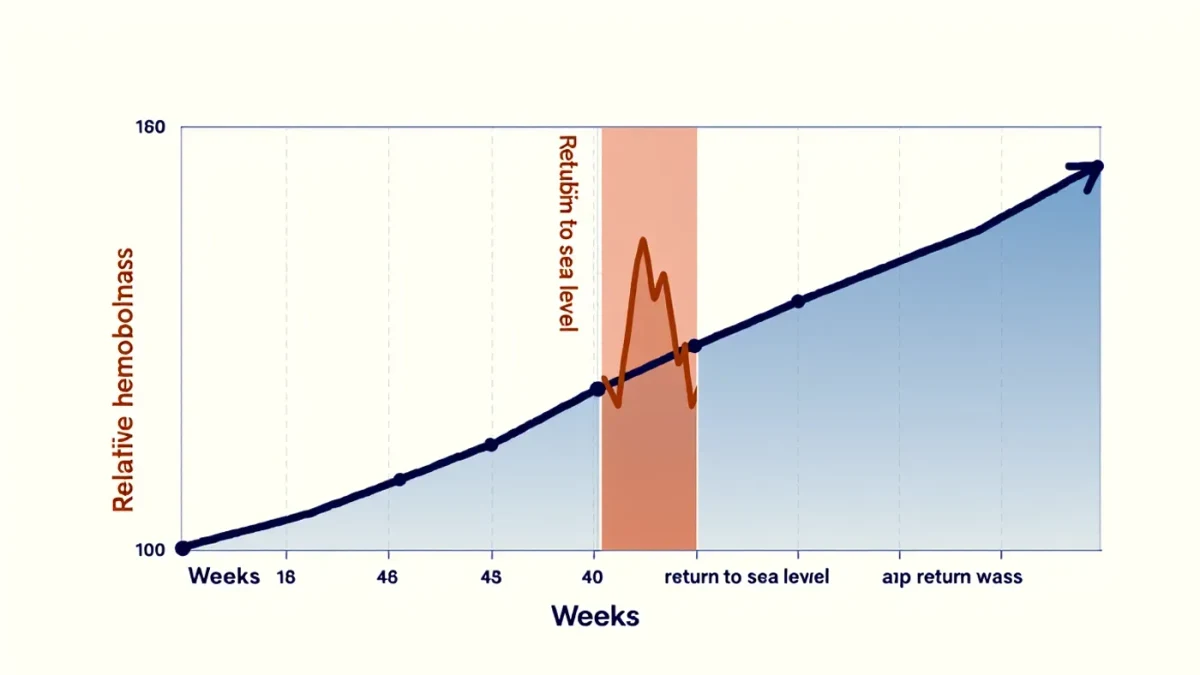
Exposure to moderate altitude — roughly 1,800 to 2,500 meters — lowers the oxygen content of arterial blood. Within hours, the kidneys release erythropoietin, the hormone that directs red blood cell production. Over two to four weeks, total hemoglobin mass can rise, expanding the blood's oxygen-carrying capacity, alongside improvements in buffering and metabolic efficiency at the muscle.
But the same thin air degrades training quality: maximum power output drops several percent at 2,000 meters, more at higher elevations. Sprint and interval sessions at altitude are slower for the same effort — the reason early full-altitude camps often produced fit-but-flat athletes whose high-end speed eroded during the camp itself.
What did the 1997 study show?
Levine and Stray-Gundersen, then at the University of Texas Southwestern Medical Center, randomly assigned trained runners to four weeks of living at 2,500 meters while training at 1,250 meters, living and training at altitude, or living and training at sea level. The live high, train low group improved 5,000-meter time trials by about 1.5 percent on average; the full-altitude group improved no more than the sea-level controls. The design isolated the mechanism: athletes whose hemoglobin mass rose improved; those whose did not, did not.
The study remains the reference point because it was controlled, randomized and performance-measured — three qualities much of the altitude literature still lacks.
How high, how long, how often?
The dose-response derived from the accumulated research, summarized in a 2013 consensus statement on altitude training by an international group of researchers, converges on: live above roughly 2,000 meters, accumulate more than 12 to 16 hours per day of exposure, hold it for at least three to four weeks, and time the return so competition falls roughly one to three weeks after descending, when the performance bump is most likely present before plasma-volume adjustments wash it out.
Shorter trips — a week of skiing at 2,000 meters — do essentially nothing for hemoglobin mass. Weekend altitude is a holiday, not a camp.
Who responds and who does not?
This is the part brochures omit. Studies measuring hemoglobin mass response to identical altitude exposure find responders and non-responders in roughly balanced proportions — some athletes add several percent hemoglobin mass, others none, with iron status a major modifiable factor. Athletes who arrive iron-deficient blunted their own erythropoietic response; baseline ferritin screening is standard practice among teams that take altitude seriously.
There is no reliable test that predicts response in advance, so teams increasingly use a test camp and measure hemoglobin mass directly before committing a season to it.
What about simulated altitude?
Altitude tents and nitrogen rooms reproduce the hypoxic exposure without the mountain. The evidence is thinner than for terrestrial camps: nitrogen-house studies, including work from the Australian Institute of Sport using full-night exposure at simulated 3,000 meters, have produced hemoglobin gains and modest performance improvements in some trials, but typical tent protocols — eight or nine hours a night, simulated 2,500 meters — sit at the low edge of the effective dose. Tents also degrade sleep quality for many users, which can quietly cancel the physiological upside.
Intermittent brief exposure devices, which cycle hypoxic air for minutes at a time, have not demonstrated meaningful hemoglobin or performance effects in controlled work and cannot be recommended on current evidence.
Is the gain worth the cost?
A 1 to 2 percent improvement in a well-controlled, four-week block is meaningful for a national-level runner — over a 10-minute 5K, that is 6 to 12 seconds. For a club athlete, the same block costs four weeks of travel, disrupted routines and, often, worse sleep. The honest comparison is against what else those weeks could buy: iron-status correction, consistent sleep, and uninterrupted training at sea level move performance by comparable margins with more certainty.
Doping aside — erythropoietin abuse mimics the adaptation artificially and is banned — altitude remains one of the few legal, genuinely ergogenic environmental strategies in endurance sport, with an effect size best described as small and reliable only on average.
When should you compete after coming down?
The descent timing is where good camps go wrong. The classic pattern from the research: performance often dips in the first days after descent while plasma volume readjusts, peaks somewhere around one to three weeks out, and drifts back toward baseline by four weeks if no re-exposure occurs. Athletes racing the weekend after a month-long camp sometimes meet their worst timing window of the year.
Because individual timing varies, most national federations now schedule a tune-up race in the second week after descent, using the result to calibrate the peak. Writing the competition calendar backward from the camp dates — not booking flights first — is the discipline that separates altitude programs from altitude vacations.
The bottom line
Live above 2,000 meters for at least three to four weeks, train low where the air is thick, screen iron first, and expect a gain measured in single-digit percents — and only if your hemoglobin mass actually responds. Everyone else should treat altitude as one option among several, not a shortcut. The primary research is catalogued on PubMed.