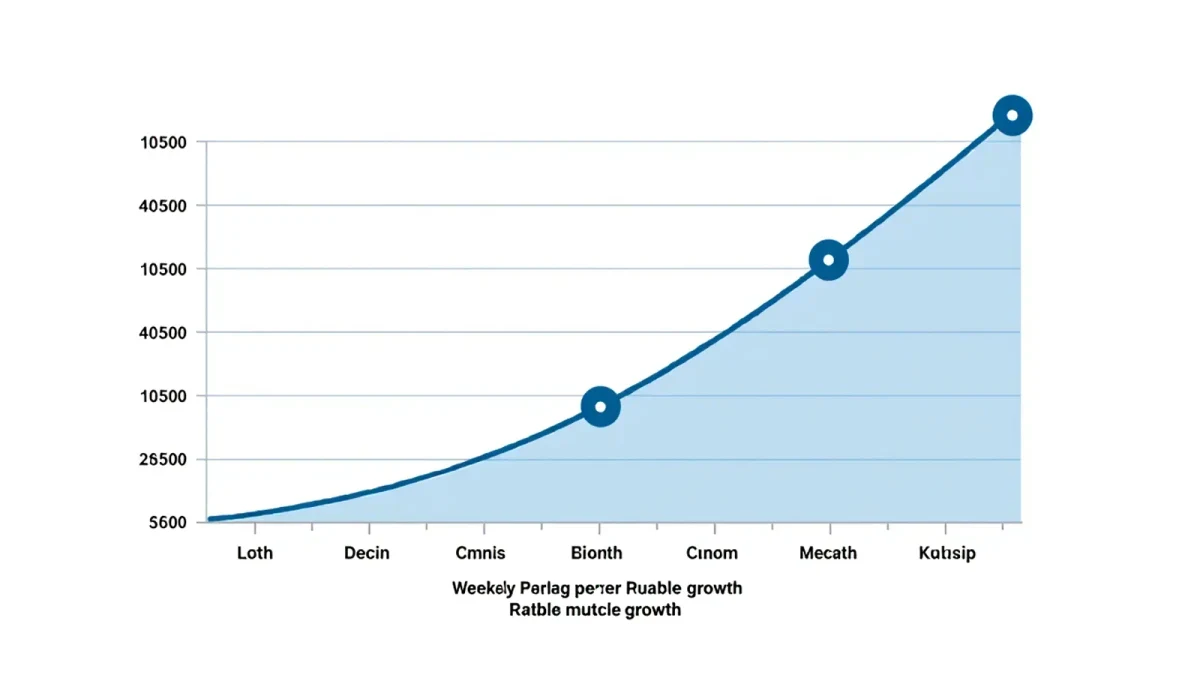
Tempo lifting — deliberately slowing repetitions — does not build more muscle than normal-speed training despite two decades of super-slow marketing, and the best direct evidence says it usually builds slightly less. In a 2015 eight-week trial by Brad Schoenfeld and colleagues, young men training with a super-slow protocol gained strength and size, but the group lifting at a controlled normal tempo achieved comparable or better results while moving far more total weight per session.
That distinction — comparable muscle, less total work — is the whole story of tempo in one sentence. Slow reps are not useless. They are an expensive way to buy fatigue.
What does tempo actually refer to?
Tempo is the speed at which each phase of a repetition is performed, usually written as concentric-pause-eccentric counts: two seconds up, no pause, three seconds down, for example. The eccentric phase is the lowering half, where the muscle lengthens under load; the concentric phase is the lifting half, where it shortens.
Coaches manipulate tempo for specific reasons — teaching control to beginners, limiting momentum in rehabilitation-adjacent settings, or exposing a weak range of a lift. What tempo is not, on the current evidence, is a standalone hypertrophy multiplier. The trials that compared matched programs across different speeds found muscle growth tracked total training volume far more closely than rep speed.
What did the super-slow research find?
The most cited head-to-head is Schoenfeld's 2015 study: 21 young men, eight weeks, identical exercises with loads set relative to each tempo's maximum, one group at a five-second-up, ten-second-down super-slow tempo and one at one second up, two seconds down. Both groups grew. The super-slow group, however, accumulated substantially less total training volume because each rep consumed so much time — and the practical lesson stuck: slowness taxed the work capacity without adding growth.
The result rhymes with exercise physiology's simpler explanation. Muscle responds to how much hard work it does near failure, and any scheme that slashes work per hour without adding stimulus per rep pays for novelty with adaptation.
A caveat worth keeping: the super-slow literature studied deliberate ten-second lowering phases, not the two-to-three-second controlled eccentrics most good coaches already program. No trial demonstrates that a gentle, controlled tempo harms gains, and there are practical reasons — joint comfort, technique quality, honest load selection — to keep it.
Do slow eccentrics damage more muscle?
The phrase "eccentrics cause more muscle damage" is true in a narrow, mechanical sense. Lengthening contractions produce more force per unit of muscle and more of the micro-damage that precedes repair. What does not follow is the old assumption that more damage equals more growth. Later research on markers of damage and hypertrophy found the two correlate poorly — and in trained lifters, soreness-heavy protocols often impair the rest of the training week more than they add to it.
The practical consensus among exercise scientists is blunt: chasing soreness is chasing a symptom. Programs built around excessive eccentric stress have produced similar or worse hypertrophy than volume-matched controls, with worse recovery between sessions.
When is a slow tempo the right tool?
There are three legitimate uses. First, learning: beginners who lower a bench press in free fall learn nothing except how to miss. A three-second lowering count builds the movement map that later heavy loads depend on. Second, sticking points: a controlled pause at a lift's hardest position — a two-count in the bottom of a squat — exposes the weak range without special equipment. Third, load-limited situations: a lifter working around a cranky shoulder, under professional guidance, may use slow tempos to make light weights meaningful, which is a clinical decision rather than a mass-building one.
Note what is absent from that list: shocking the muscle into new growth. Programs are not shock therapy, and the evidence does not support tempo rotation as a plateau-breaker.
How should a typical lifter set their tempo?
The default the research best supports is boring and effective: lift the weight with intent — as fast as practical effort allows given the load — lower it under control in two to three seconds, and let reps, sets and load do the talking. Intent-to-move-quickly on the concentric has a small evidence base in strength contexts; the wider tempo literature is collected in the PubMed-indexed tempo studies.
A practical tempo scheme for main lifts looks like the table below.
| Situation | Concentric | Eccentric | Purpose |
|---|---|---|---|
| Main compounds, general training | Fast intent | 2-3 s | Maximize load and volume quality |
| Beginners, first months | Controlled | 3 s | Movement learning, joint comfort |
| Sticking-point work | Controlled | 2 s + pause | Expose weak range |
| Rehabilitation-adjacent, professionally guided | Slow | Slow | Meaningful load at low joint stress |
Does tempo matter more in bodyweight training?
More than in barbell work, and for an obvious reason: with bodyweight training, tempo and leverage are the load knobs. Slowing a push-up until a set of eight becomes hard substitutes for adding plates. That makes slow tempos genuinely useful in minimal-equipment contexts — not because slowness itself is anabolic, but because it raises the relative intensity of a fixed load.
The same logic applies to pull-ups, split squats and rows performed at home. If the resistance cannot increase, time under tension close to failure is one of the few progressive levers left, and it works for the same reason all hypertrophy works: hard sets done near failure, accumulated consistently.
What is the honest summary on tempo?
Control the lowering, lift with intent, and spend your programming attention on volume and progression. The slow-rep revolution has been promised since the 1990s, and the controlled trials keep declining to arrive for it. What has arrived instead is a quieter, more useful finding: tempo is a tool for controlling movement quality and relative intensity, and neither job requires a stopwatch set to ten seconds.
Do paused reps count as tempo work?
Pauses are tempo's stricter cousin, and they earn their place differently. A pause — one to two seconds with the bar on the chest or in the hole of a squat — removes the stretch reflex entirely, forcing a pure concentric contraction from a dead stop. That is why powerlifters use paused work to attack the exact ranges where the stretch reflex normally rescues them, and why it carries over honestly to competition rules that demand stillness.
Paused reps cost load, usually five to ten percent, and that cost is the point. They are a specificity tool for lifters who need strength without momentum, not a growth shortcut. Treated that way, they slot into a program for a three-to-four-week block and leave without ceremony.