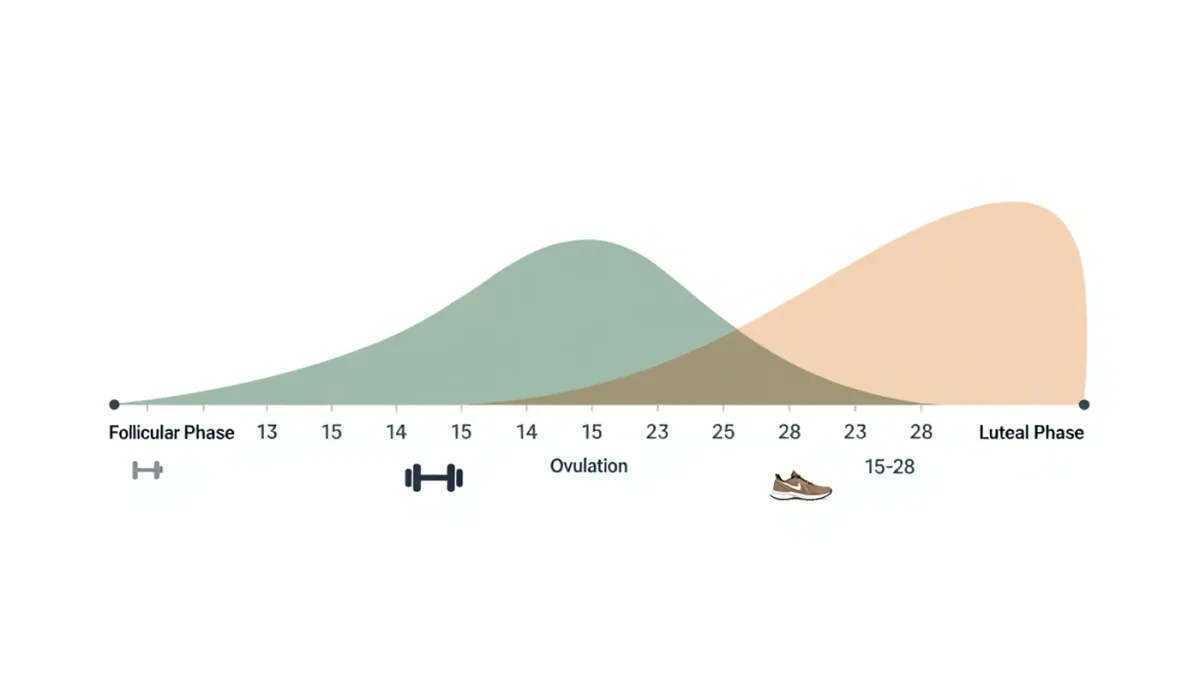
Cycle-based training — adjusting workout type and intensity to menstrual-cycle phase — currently rests on evidence too thin to prescribe from: reviews of the literature, including a 2021 systematic review by Meignié and colleagues, find that most studies show no reliable performance differences between cycle phases, that the minority of positive findings conflict with each other, and that trials are typically small, short and methodologically uneven. The honest position is not that phase does not matter, but that the research has not yet shown what phase-specific programming its popular versions assume.
What does the cycle change, physiologically?
The two governing hormones are estrogen, which peaks around ovulation, and progesterone, which dominates the second half of the cycle. Both influence more than reproduction: estrogen touches collagen metabolism, glycogen storage and temperature regulation, while progesterone raises resting body temperature and acts on the central nervous system. Fluid balance shifts across the cycle too, which is why body weight and perceived bloating move independent of training quality.
That these hormones do things is not in dispute. The open question is whether the shifts are large enough to require changing a training plan — and on that, the data are genuinely mixed.
What have studies actually measured?
Researchers have tested strength, endurance, sprinting, anaerobic power and neuromuscular control across cycle phases for decades. The pattern — or absence of one — is striking: systematic reviews covering dozens of trials conclude that where statistically significant phase effects appear, they point in different directions in different studies, and effect sizes are small. A widely cited review by Julie Greaves and colleagues in 2011, updated by later work including the 2021 Meignié review, found no consistent evidence that strength or endurance performance varies reliably with cycle phase.
Notable caveats cut both ways. Many older studies verified phase only by calendar, not by hormone measurement — a weakness later work corrected, largely without changing the picture. And most samples are small, often ten to twenty participants, too few to detect anything but large effects.
Why are period-tracking apps and programs ahead of the data?
Market timing. Female athlete consumer spending grew faster than the supporting literature, and programs selling phase-matched workouts filled the gap with physiological plausibility rather than trial results. The typical product story — go hard in the follicular phase, recover more in the luteal phase — draws on real hormone curves but has never been confirmed by a controlled trial showing phase-matched programming beats ordinary good programming.
What the trials do support is less cinematic: train consistently, manage overall load, and take individual symptoms seriously when they arrive.
What about symptoms and iron?
Two areas hold firmer ground. First, symptom-driven adjustment: athletes experiencing heavy bleeding, cramping or premenstrual symptoms in a given week commonly and sensibly shift hard sessions by a day or two — that is responsiveness, not periodization. Heavy menstrual bleeding also interacts with iron status, and iron deficiency, which disproportionately affects female athletes, demonstrably impairs performance when present. Screening and correcting iron is one of the highest-yield interventions in women's sports medicine, documented across sports-science literature.
Second, cycle monitoring as health surveillance: irregular or absent cycles in an athlete signal low energy availability — a warning flag addressed in the International Olympic Committee's consensus on relative energy deficiency in sport. Tracking the cycle to catch that signal has stronger justification than tracking it to choose Thursday's workout.
Does hormonal contraception change the picture?
It flattens it. Combined oral contraceptives suppress the natural hormone cycle and provide steady synthetic hormone levels, which in principle removes the very fluctuations phase-based programming organizes around. Studies comparing users and non-users generally find small or no performance differences — the topic deserves more research, but there is no evidence that contraceptive users need phase-based plans at all.
What should athletes actually do?
- Keep training structured around progressive overload, not calendar phase.
- Log cycles alongside training and adjust hard sessions around real symptoms, not predicted hormone curves.
- Check iron status periodically, especially with heavy periods.
- Treat cycle irregularity as a health signal worth discussing with a sports physician.
- Be skeptical of any program selling phase-matched workouts as proven.
Why is this research so hard to do?
The practical obstacles explain much of the fog. A menstrual cycle study done properly needs hormone verification — blood or urine samples at multiple time points to confirm which phase each athlete is actually in, since cycle length varies widely and self-reported phases misclassify frequently. Each participant then contributes only a couple of data points per month, stretching a simple design into a multi-month study with high dropout risk.
Add the heterogeneity problem — oral contraceptive users, different contraceptive types, irregular cycles — and the clean sample fragments into small subgroups that lack statistical power on their own. Reviews keep concluding that the literature is qualitatively suggestive and quantitatively weak for the same structural reasons, not because researchers are uninterested.
Better trials are now running with hormone-verified phases and larger cohorts, and the picture may firm up in the next several years. Until then, a generic phase chart on a training app is a hypothesis wearing a program's clothes.
The bottom line
The female physiology research base is growing, and better-designed trials with hormone verification and adequate sample sizes may yet find phase effects worth programming around. As of the studies published to date, they have not. An athlete's own logged response to training across a cycle beats any generic phase chart — individual data is the only cycle-based evidence that applies to you. The literature is catalogued on PubMed.