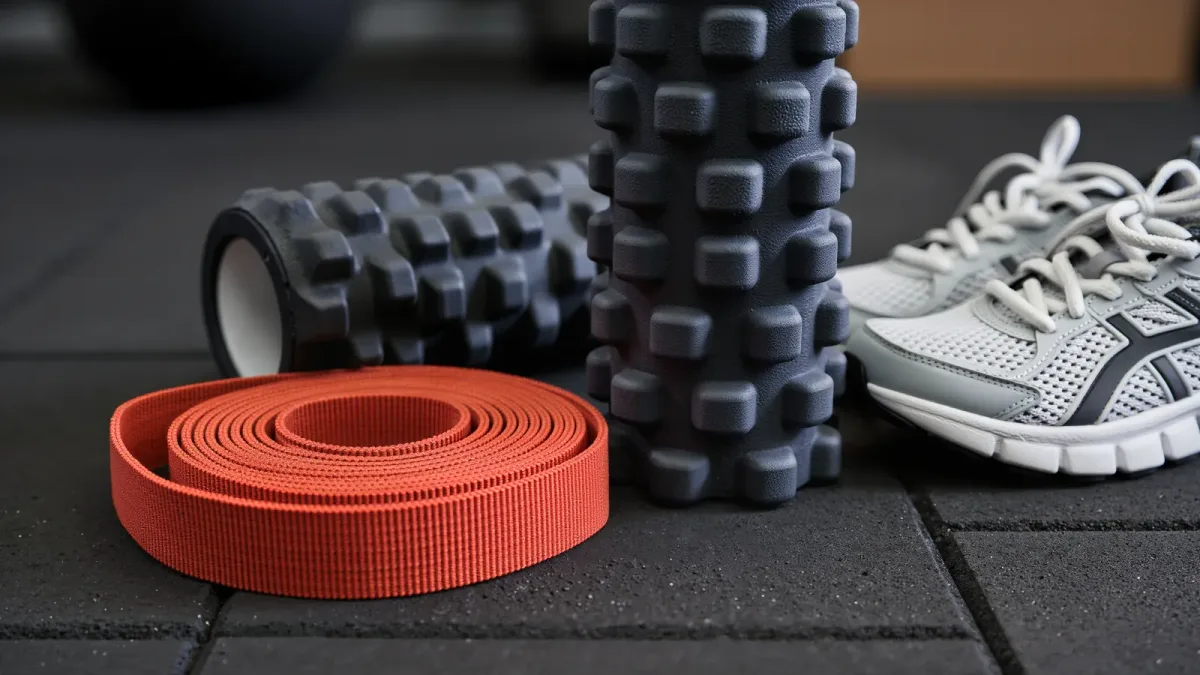
Mobility training and static stretching differ in one decisive way: static stretching, holding a muscle at length for 30 seconds or more, reliably increases range of motion, with reviews concluding the gains come largely from increased stretch tolerance rather than longer tissues, while mobility work, moving joints actively through range, improves the control and strength you have inside that range. Neither practice has strong evidence for injury prevention on its own. The research base, summarized in reviews by David Behm and colleagues and in work on stretching and muscle architecture from institutions including the University of Montreal, supports range and warm-up effects, not the folklore either practice attracts.
Persistent pain with movement or stretching warrants evaluation by a qualified professional.
What Does Static Stretching Actually Change?
A held stretch produces two measurable effects, and separating them explains most of the confusion. Immediately, a stretched muscle shows greater range of motion: the classic finding, quantified in systematic reviews on stretching, is a small to moderate acute increase in range, roughly 3 to 8 degrees at common joints, that fades within an hour. Chronically, regular stretching programs of several weeks produce lasting gains in range of motion, on the order of 10 to 15 degrees in many trials.
The mechanism debate was largely settled by the stretch-tolerance literature reviewed by Weppler and Magnusson: for typical stretching doses, muscles do not lengthen permanently in any structural sense. The nervous system simply permits more range, the sensation of stretch recalibrating at a given joint angle. That is not a knock on the adaptation; being able to reach further is a real capacity. It just means stretching behaves more like sensory training than like pulling taffy.
Does Stretching Before Exercise Hurt Performance?
Long holds before explosive work do, modestly. The most cited meta-analysis in this line, Behm and Chaouachi's 2011 review for the American College of Sports Medicine umbrella of research, found that static stretches held about 60 seconds or longer reduce subsequent maximal strength and power by roughly 5 percent on average, with smaller or negligible effects for holds of 30 seconds or less. Dynamic warm-ups, moving through range with progressively larger amplitude, show no such penalty and small positive effects on power tasks.
The practical translation is timing, not prohibition: long static stretching belongs after training or in standalone flexibility sessions, while the pre-training window belongs to dynamic mobility and specific warm-up work. That structure dominates modern practice precisely because it matches the acute-evidence pattern.
What Is Mobility Training Supposed to Do?
Mobility training is the umbrella term for active range-of-motion work: controlled articular rotations, loaded end-range holds, dynamic drills, and strength work through full range. Its premise is that usable range, range you can control and load, matters more than passive range you can only slump into. The strength-through-range literature gives the premise real support: resistance training through a full range of motion increases flexibility comparably to stretching in several head-to-head trials, and loaded stretching approaches, such as heavy loaded stretches used in some strength research, improve both range and the capacity to produce force at length.
What mobility work lacks is a sharp research identity. Few trials define mobility training precisely enough to pool results, and the term covers everything from physical-therapy-inspired joint circles to gym loaded-mobility systems. The honest summary: mobility training inherits evidence from its ingredients, full-range strength work and active movement, rather than owning a strong trial base under its own banner.
Does Either One Prevent Injuries?
This is where both practices' marketing outruns the record. Systematic reviews of stretching interventions, including the oft-cited work associated with the Cochrane Collaboration and subsequent reviews on stretching and injury risk, concluded that stretching alone does not meaningfully reduce overall injury rates in sport. Injury risk is multi-factorial: load management, strength, previous injury, and sleep all carry evidence of their own. A joint with more usable, controllable range under load plausibly tolerates awkward positions better, and strength programs do show injury-protective associations in trials such as the Nordic hamstring exercise research in elite football, which cut hamstring injury rates roughly in half. But attributing that protection to mobility or stretching specifically is a step the data has not taken.
| Quality | Static stretching | Mobility training |
|---|---|---|
| Acute range gain | Yes, 3-8 degrees, fades within an hour | Yes, smaller, movement-specific |
| Chronic range gain | Well documented, ~10-15 degrees over weeks | Documented via full-range strength work |
| Force at end range | Not improved | Improved when loaded |
| Pre-workout effect | Possible ~5% power drop after long holds | No penalty, mild warm-up benefit |
| Injury prevention | Not demonstrated alone | Not demonstrated alone |
How Much Stretching Is Enough to Gain Range?
The dose-response reviews converge on a floor of about 30 to 60 seconds of total stretching per muscle per day, five to six days per week, with gains plateauing after roughly two to three minutes per muscle. Intensity should be moderate, around 4 or 5 out of 10 discomfort, since harder stretching adds soreness more than range in the trials that compared intensities. A realistic weekly commitment is 10 minutes, most days, for the two or three positions that matter for your training. Consistency beats duration in every dose-response analysis published to date, which is why the floor is described in seconds per day rather than hours per week.
Which One Should a Lifter or Runner Choose?
The evidence supports a division of labor rather than a winner. Before training: 5 to 10 minutes of dynamic mobility targeting the session's movements, bodyweight squats to depth, leg swings, thoracic rotations. After or separately: static holds for chronically restricted areas, the classic 30 to 60 seconds per position. Across the week: strength work through full range, deep squats, full-depth split squats, overhead pressing from standing, which builds range and the ability to use it at the same time. Runners with genuinely limited ankle or hip range, a qualified professional should assess, may find a few targeted holds reduce the compensations that show up late in long runs.
Neither practice needs an hour or a guru. The range you can already control is worth more than the range you can only borrow from a held stretch, and the fastest way to keep both is to load what you own and stretch what you do not.
The Bottom Line
Static stretching is the better-tested tool for increasing passive range, through stretch tolerance, and best deployed away from hard training. Mobility training is the better framework for making range usable, and it borrows its evidence from full-range strength work. Both sit downstream of load management and strength in the injury-prevention hierarchy, and any promise beyond that is marketing, not mechanism.