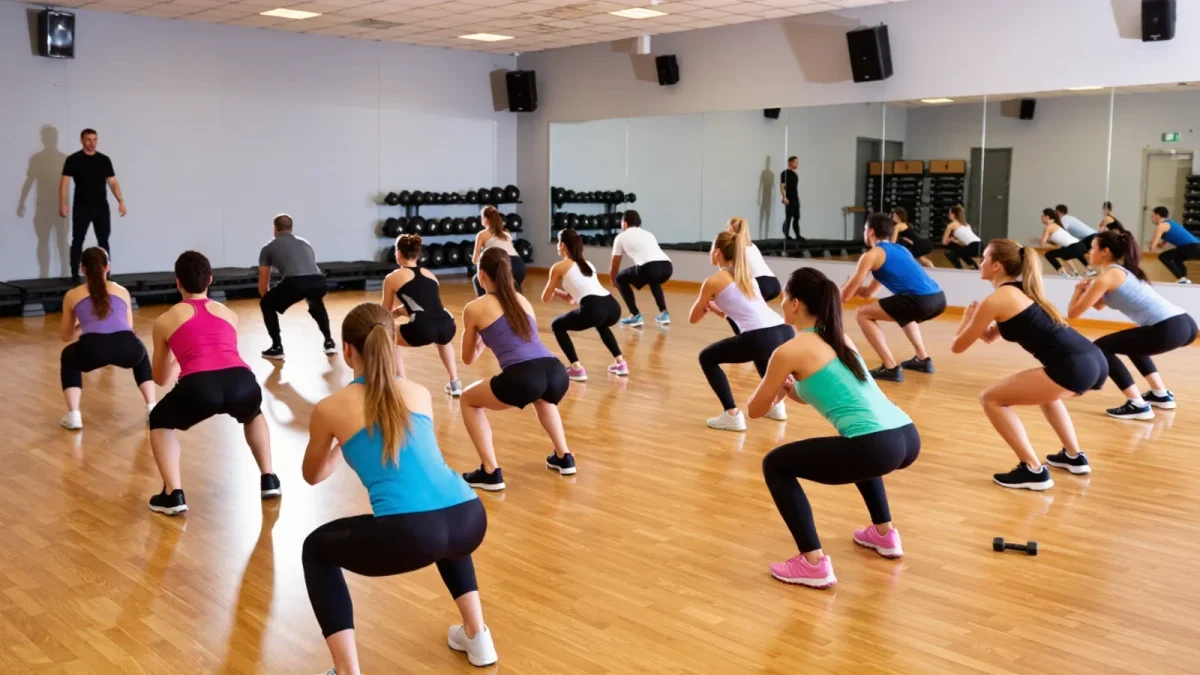
Group fitness classes measurably improve adherence, the single best predictor of whether an exercise program works, because exercising with others converts a willpower task into a social commitment. A 2017 study in the Journal of the American Osteopathic Association by Dayna Yorks and colleagues found that medical students assigned to group exercise sessions for twelve weeks reported about a 30 percent improvement in perceived stress and significantly better physical, mental, and emotional quality-of-life scores than those training alone, whose stress barely moved. The adherence half of the story is even better established: across behavioral research, from the U.S. Physical Activity Guidelines advisory evidence onward, social support and enjoyment consistently rank among the strongest predictors of who is still exercising a year later.
Why Does the Social Version Stick Better?
Three mechanisms carry most of the weight in the behavioral literature. The first is commitment: a class has a fixed time, a booked spot, and often a late-cancellation fee, and each of those raises the cost of skipping. Behavioral research on commitment devices shows even small friction shifts follow-through. The second is what sport psychologists call the Köhler effect, documented in experiments by Norbert Kerr and extended to exercise by Michigan State researchers including Deborah Feltz: in a group task, individuals work harder than they would alone rather than be the weakest link, an effect demonstrated with measurable effort gains in virtual partner experiments. The third is identity: self-categorization research, associated with the social-identity tradition in group dynamics, finds that people who come to see themselves as members of a class, the Tuesday 6 a.m. crew, internalize the habit rather than renting it.
None of this requires the class to be technically superior. The programming is often ordinary. The delivery is the active ingredient.
What Did the Best-Known Trials Find?
Beyond the Yorks study, several lines converge. Wearable and gym-attendance data analyses have found that people who take classes, or train with others, show higher visit frequency and lower dropout over follow-up windows than solo gym users, though these are observational comparisons, and self-selection, the already-committed choosing classes, explains part of the gap. On the mental-health side, a large cross-sectional study of 1.2 million U.S. adults by Chekroud and colleagues, published in The Lancet Psychiatry in 2018, found all exercise associated with fewer poor mental-health days, with team sports showing the largest association, roughly 23 percent fewer bad days versus not exercising. Correlation, yes, but the pattern repeats across cohorts: the social formats overperform.
The honest caveats are two. Class research often involves small samples and short durations, and industry funding is common in studies bearing brand names, which is a reason to read effect sizes rather than press releases. The direction of the evidence, however, has been stable for decades: company helps.
Which Class Formats Show the Strongest Pull?
Adherence research does not crown one modality, but the formats that retain best share structural features: fixed scheduling, a named instructor who notices absences, progressive content that rewards attendance, and a cohort that regulars recognize. In practice that describes instructor-led small-group strength programs, established indoor-cycling studios with metric screens and rider rankings, and running clubs, which have boomed since the mid-2020s and function socially like classes. Competitive elements help some people and repel others; the Köhler-effect work suggests the useful version is mild upward comparison, not public leaderboard shame.
| Feature | Effect on adherence | Evidence source |
|---|---|---|
| Fixed schedule and booking | Higher attendance | Commitment-device research |
| Trained with others vs alone | Greater effort and enjoyment | Köhler-effect experiments |
| Team or group formats | Largest mental-health association | Chekroud et al., Lancet Psychiatry |
| Instructor recognition | Lower dropout | Gym attendance analyses |
Can a Class Beat a Personal Program?
For results per hour, a well-run individual program usually wins: it is built around one person's gaps, schedule, and progression. For results per year, the class frequently wins, because it survives. The exercise-science literature is blunt that the superior program is the one that is actually completed, and U.S. Physical Activity Guidelines framing treats adherence as a central outcome rather than a footnote. A sensible hybrid many coaches recommend: two group sessions for the social anchor, plus one or two solo sessions for individualized weaknesses. The class is the appointment that protects the habit; the solo work is where the specific adaptation happens.
Who Should Not Bother With Classes?
Some readers genuinely do better alone. People whose schedules shift weekly, shift workers, caregivers, frequent travelers, lose the fixed-schedule benefit that drives much of the adherence gain. Strongly self-determined exercisers, in the self-determination theory sense, those who train from intrinsic enjoyment rather than obligation, show smaller gains from external structure. And anyone who finds group settings draining rather than energizing, a real personality dimension, not a flaw, may find a class adds an avoidance motive that costs more than the commitment benefit pays. For these readers, a standing appointment with one training partner captures most of the social mechanisms at lower social cost.
How to Pick a Class That Will Still Have You in December
The retention predictors translate into a practical checklist. Choose a class at a time you have kept free for four consecutive weeks before, not a time you aspire to. Pick one where the instructor learns names within two sessions, since instructor recognition tracks dropout in attendance data. Prefer formats with progressive skills, dance, martial-arts conditioning, climbing, over pure exhaustion sessions, because skill acquisition gives the brain a reason to return beyond calorie guilt. And give any class four to six weeks before judging: the identity effects that drive long-term adherence need a cohort to form around you.
What About Online and On-Demand Classes?
Streaming workouts kept the instructor and lost the room, and the adherence data reflects that trade. Platform studies and industry retention analyses published through the mid-2020s suggest on-demand programs show steep usage decay within a few months, while live-streamed sessions with a scheduled start time and visible participants retain meaningfully better. The pattern matches the mechanism list: a video on demand supplies programming but no commitment device, no waiting cohort, no one who notices an empty bike. Livestreams restore some of it. Readers who train at home get the most from the format by recreating the missing pieces deliberately, a fixed calendar slot, a friend joining remotely, or a small standing group whose members expect each other to appear.
The Bottom Line
The data says the social wrapper is not decoration. Group classes ride the strongest adherence mechanisms behavioral science has documented, commitment, mild social pressure, and identity, and the mental-health associations of group formats are among the largest in the observational literature. For the many adults whose fitness fails at the habit stage rather than the programming stage, the class is not the compromise option. It is the evidence-based one.