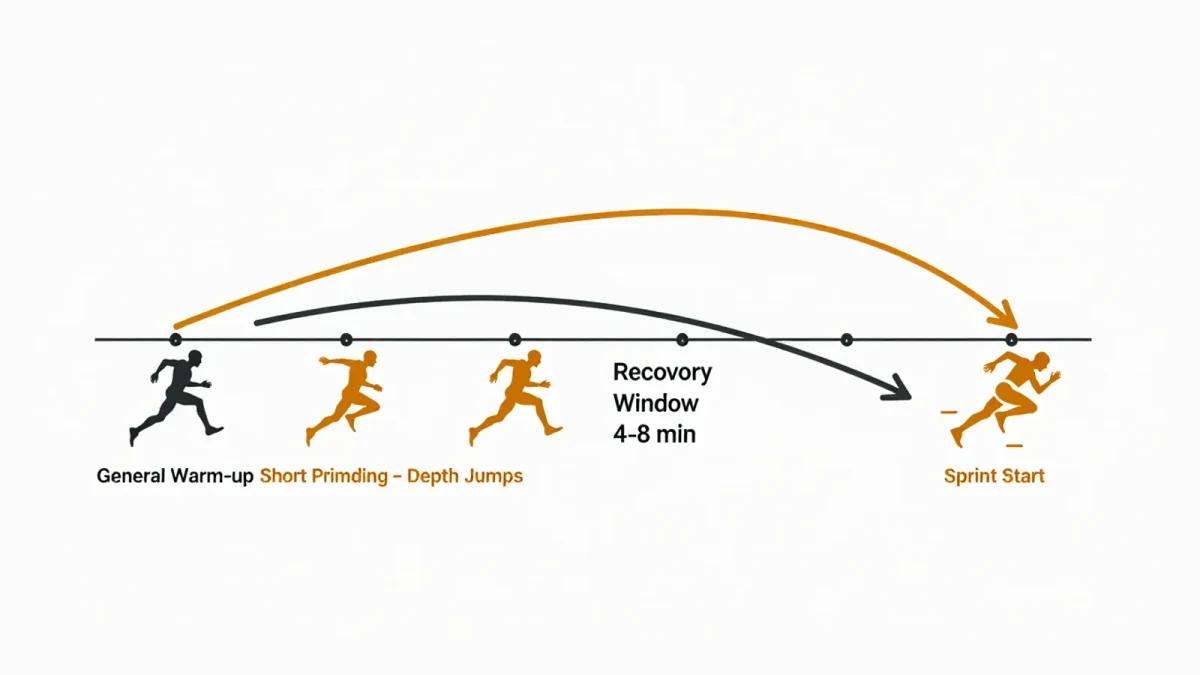
Adding a brief, heavy or explosive conditioning activity to your warm-up, a practice researchers call post-activation performance enhancement, or PAPE, acutely improves jump performance in trained athletes, and can improve sprinting, but the effect lives inside a narrow recovery window and does not appear for everyone. A 2025 study by Celik and colleagues published in Scientific Reports found a 2.93 percent improvement in 20-meter sprint time one minute after a dynamic warm-up plus three depth jumps.
Individual readiness and injury history should be weighed with a qualified coach before adding explosive priming to a warm-up.
What is PAP, and how is it different from PAPE?
Post-activation potentiation, or PAP, is the classic physiological term: a heavy contraction temporarily increases the force a muscle can produce, through mechanisms thought to include greater sensitivity of the muscle's contractile proteins to calcium. Researchers increasingly prefer the broader term post-activation performance enhancement, PAPE, because what coaches actually measure is not a muscle twitch but a jump height or a sprint time, which blends potentiation with residual fatigue from the priming activity itself.
That blend is the whole practical problem. Every priming activity starts two clocks at once: a potentiation effect that fades over minutes, and a fatigue effect that also fades over minutes. Performance peaks in the gap when potentiation is still high and fatigue has already drained, and that gap differs between athletes.
What does the evidence show?
The findings divide by movement type. For jumping, results are consistent enough that a 2026 review in Sports Medicine Open concluded adding PAPE to a general warm-up acutely enhanced jump performance in trained and competitive athletes. For sprinting, the picture is genuinely mixed. Celik's 2025 study found depth jumps improved 20-meter time by 2.93 percent at a one-minute recovery. But a 2024 critical review by Gautam and colleagues noted that sprint performance may not improve at all, with several analyses suggesting acute impairment when the priming activity is poorly dosed.
Older work fills in the background. Sanchez-Sanchez and colleagues' 2018 study compared a traditional warm-up with two different priming protocols before repeated sprint efforts and found the outcome depended on how the priming was constructed, not simply whether it was included. Across the literature, trained athletes respond more reliably than untrained ones, because their nervous systems both potentiate more and fatigue less from the same stimulus.
Which priming methods have been studied?
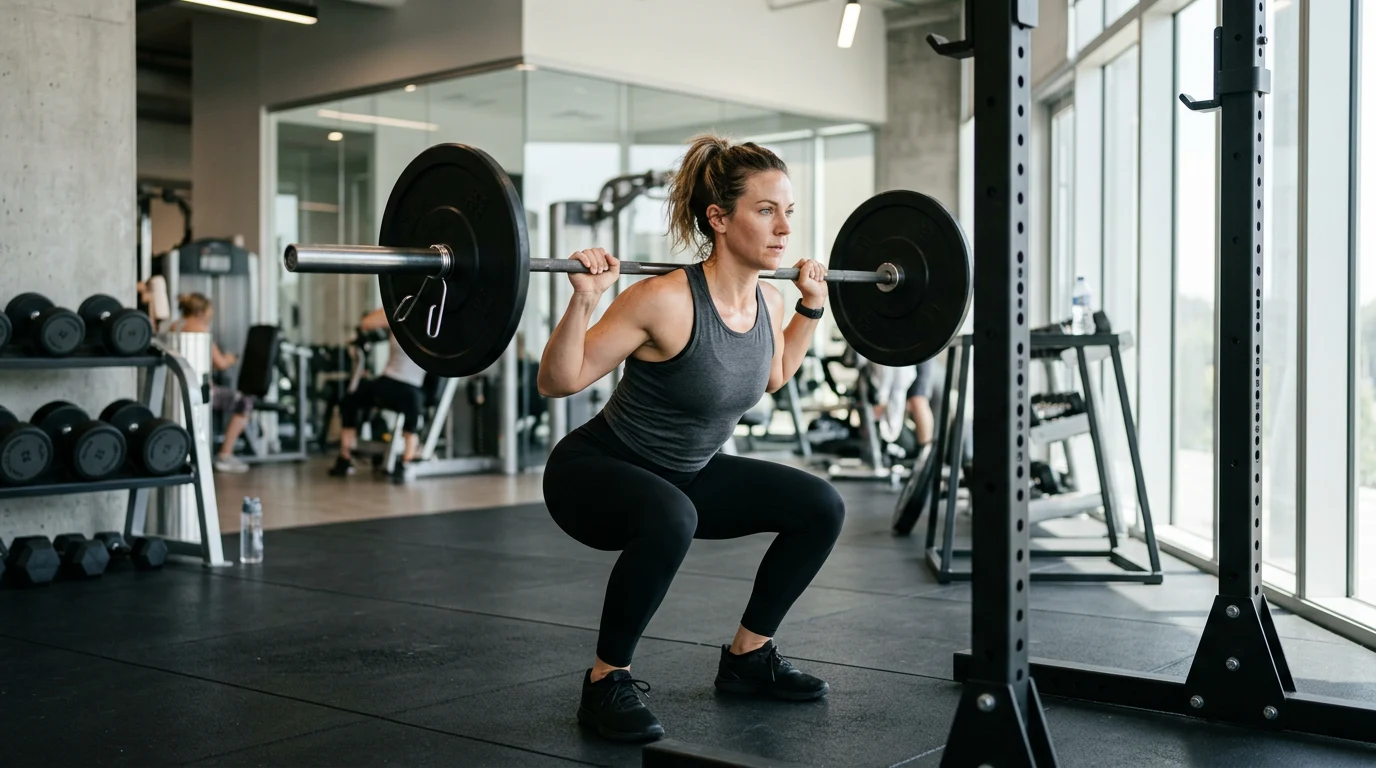
Three families dominate the research: heavy resistance work such as weighted squats at high loads for low reps; explosive, plyometric work such as depth jumps or loaded jumps; and resisted sprints. Each shifts the potentiation-fatigue balance differently. Heavy loading produces a strong potentiation signal but more fatigue; plyometric priming is lighter on the system and suits athletes without barbell access on competition day.
The dosing pattern across studies is short: a few sets, one to five repetitions, with minutes of recovery before the competitive effort. Celik's protocol, three depth jumps, is representative of the minimal-dose end of that range.
Why does timing decide everything?
The recovery window is the most replicated finding in this literature. Test too early, within the first minute or two after heavy priming, and fatigue can dominate, leaving the athlete slower. Test in the typical four-to-eight-minute window and potentiation often wins. Wait too long, beyond roughly 12 to 15 minutes in many protocols, and both effects have faded, leaving an ordinary warm-up. Stronger athletes tend to peak earlier, which is why the same protocol that helps one athlete can hamstring a training partner.
That variability is why the research consensus supports individual testing: try the protocol in training, with a stopwatch or a jump mat, before betting a competition on it.
Who should skip priming altogether?
Several groups have good reasons to leave the practice alone. Athletes returning from injury, whose tendons and muscles may not tolerate explosive loading at competition intensity, gain risk without proven reward. Beginners respond weakly in the data, because potentiation scales with training status, and their session time is better spent on technique. And any athlete whose competition schedule compresses the timeline, with events stacked a few minutes apart, cannot reliably reach the recovery window at all.
Even for suited athletes, priming belongs at the sharp end of a season, before finals and peak efforts, rather than in every session. Used weekly in ordinary training, it adds fatigue the body must absorb and muddies the signal of the session itself.
Where is the research heading?
Recent work is moving from whether priming works on average to who it works for. Individual-response analyses, repeated-measures designs and better controls for athletes' strength levels are slowly replacing one-size-fits-all group averages, and the 2026 review's trained-versus-recreational split is a product of that shift. Wearables that quantify readiness may eventually sharpen the timing decision, but as of the current literature no commercial device has been validated for that specific call.
How could you test it yourself?
A simple self-experiment follows the shape of the published studies. Establish a baseline, say a standing jump or a 20-meter sprint, after your normal warm-up on several separate days. Then, on matched days, add a short priming block, for example three depth jumps or two low-rep heavy squats, wait a fixed interval such as four minutes, and retest. Alternate the wait time across weeks. If the primed result beats baseline reproducibly, the protocol works for you; if it does not, your warm-up was already doing its job.
The honest summary of the evidence: priming is a real, measurable effect with a modest average size, a trained-athlete bias and a timing window that punishes guesswork. It is a refinement for athletes who already warm up well, not a substitute for warming up at all.